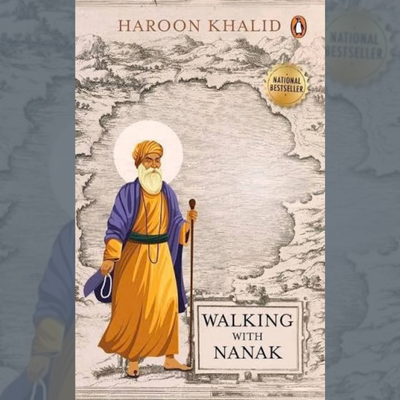
I almost didn’t read this book. The title alone made me brace for something devotional, something that would ask me to sit still and be reverent for three hundred pages. I have spent enough of my life resisting things I was told to revere without question that I approached Walking with Nanak expecting to perform patience rather than actually read it. I thought I knew what kind of book this would be before I opened it, and I was prepared to be bored by my own predictions.
I was wrong within the first fifty pages.
What Haroon Khalid does, and what I did not expect anyone to do with a figure like Guru Nanak, is refuse to flatten him into a saint. Nanak here is not a finished answer handed down from some untouchable height. He is a man in motion, restless, unconvinced by the world as it was given to him, walking from town to town because staying still meant accepting things he could not accept. He questions the priesthood. He questions the caste order. He questions rituals performed out of habit rather than conviction, the kind of inherited practice nobody examines because examining it feels dangerous. Khalid, in one line early in the book, describes Nanak as a man who was,
even to those closest to him, someone “so near and yet so elusive.” That line stayed with me longer than almost anything else in the book, because it is the exact feeling I have had about my own convictions my entire life, close enough to touch, never quite settled enough to explain to someone else’s satisfaction.
The parts of Nanak’s life that get smoothed over in the version most of us grow up with are the parts that would make any modern parent worried. As a child, he was not an easy, compliant boy performing early signs of holiness for an approving family. He was withdrawn, given to long silences, uninterested in the things that were supposed to interest him, surrounded by adults who had an explanation for every ritual except the one that actually mattered: why. When he was of age for the sacred thread ceremony, the Janeu, he refused to wear it, not out of teenage defiance, but because no one
around him could tell him what the thread was actually supposed to protect or purify, only that it had always been done. He asked for a thread of compassion and restraint instead of cotton, and the room did not have an answer for him. Reading that scene, I didn’t see a boy performing precocious wisdom for the benefit of a hagiography written after the fact. I saw a child who had been left alone with a question nobody was equipped to answer, and who kept carrying it because putting it down was never actually an option for him. If that isn’t a description of a lonely childhood, I don’t know what is.
The same refusal to accept an answer just because it was handed to him shows up again a little later, in the story of the Sacha Sauda. His father, Mehta Kalu, gave him money and sent him off to strike a profitable trade, the way any father wants a son to prove he can function in the world. Nanak took the money and used it to feed a group of hungry, unclothed sadhus he came across on the road, men who looked like they hadn’t eaten in days. When he came home with no goods and no profit, only the claim that he had made a true bargain, it must have looked to his father like failure, maybe even
foolishness. But Nanak’s economics were never going to be his father’s economics. To him, feeding someone who was starving in front of him was the only transaction that actually settled its account. Reading this alongside the Janeu scene, a pattern starts to form: this was a person who could not participate in a system, however ordinary or expected, unless he understood and believed in what it was actually for. A thread with no explained purpose. A trade with no real return. Neither one meant anything to him until he could locate the truth underneath it, and when he couldn’t, he simply built his
own version instead.
That is the part that undid me. I recognized it immediately, and uncomfortably. I have never wanted to conform simply because conforming was easier or expected of me, and I have paid for that in the usual ways people pay for it: being called difficult, being asked why I can’t just accept things the way they are, being treated as though questioning is itself a character flaw rather than a form of honesty. Watching Nanak refuse the same pressure, across a landscape Khalid physically retraces on foot centuries later, felt less like reading history and more like reading a mirror that happened to be very old and very patient with me.
Khalid does something else I wasn’t prepared for: he questions everything himself, at every single stop. He doesn’t accept the folk versions of these places uncritically, the way a lesser travel writer might, content to just repeat what the local caretaker tells him because it makes for a tidier story. He also doesn’t perform scepticism for its own sake, the kind of contrarianism that mistakes doubt for depth. He goes, he looks, he asks uncomfortable questions of the people guarding these shrines, and he sometimes finds something true anyway, buried under decades of institutional narrative. There is no bias smuggled in under the guise of storytelling here. That kind of honesty is rare in writing about religious history, especially religious history that people still fight over, still politicize, still use as a weapon against each other on both sides of a border that didn’t exist in Nanak’s lifetime.
One scene stayed with me the longest: the retelling of Nanak’s visit to the Jagannath Temple in Puri, sometime in the early 1500s. The priests were mid-ritual, circling a platter of lamps and incense before the deity in the traditional evening aarti, and Nanak simply didn’t join them. He kept sitting in his meditative position. When they questioned him, he didn’t apologize or explain himself in their terms. He told them that a ritual performed with a lamp and a platter was too small a container for something that was already everywhere, and then he offered them a different picture entirely; the whole sky as the platter, the sun and moon as the lamps, the stars as the pearls scattered across it, the wind itself doing the work of the fan. It wasn’t defiance for its own sake. It was that he genuinely could not perform a gesture that felt smaller than the thing it was meant to honour. Reading that scene, I felt something close to recognition. I have walked out of rituals; literal and otherwise, not because I didn’t believe in what they were reaching for, but because the reaching felt smaller than the thing itself, and I couldn’t make my body go through motions my mind had already outgrown. Nanak didn’t leave the temple because he’d stopped seeking. He left because he’d found something the platter couldn’t hold.
What struck me most, reading this as someone who works in Punjab-focused research and writing, is how much of what gets called “Punjabi identity” today has been stripped of exactly this kind of inquiry. We inherit Nanak as an institution before we ever get to encounter him as a person who was, by every account in this book, uncertain,searching, and unwilling to accept the world exactly as it was described to him. Khalid’s Pakistan-side travels through gurdwaras that exist in a country where Sikhs are a tiny minority forces a specific kind of honesty onto the material, there is no majority audience to flatter here, no political constituency to please. That absence of
an obvious agenda is, I think, exactly what let the book earn my trust as fast as it did.
I finished the book disoriented in a way I did not expect from something with “Nanak” in the title. I was so unwilling to let it end that I picked up another book immediately afterward, not because I wanted to read something new, but because I needed somewhere else to put my attention so I wouldn’t have to sit with the fact that this one was over. I have disassociated from books before in the ordinary sense people mean when they say a novel “swept them away,” but I don’t think I have ever needed an exit strategy from a book the way I needed one from this.
That is not a small thing for a book to do to a reader. It is, at this point in my life, the only thing I actually want from a book anymore; not comfort, not confirmation, but the uncomfortable experience of being seen by a four-hundred-year-old story I approached expecting to find boring.
