
How Maharaja Ranjit Singh built Asia’s most formidable army and why most Punjabis have never heard of the Frenchmen who helped him do it.
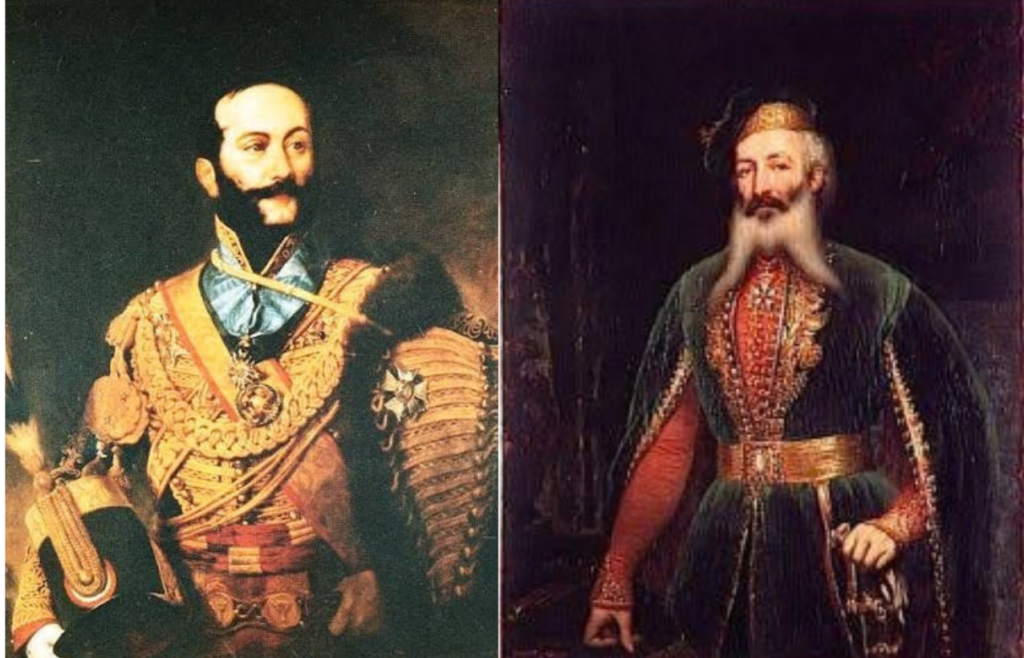
There is a strange and almost cinematic fact sitting quietly in our history books, one that most of us walked past in school without a second glance: two former generals of Napoleon Bonaparte’s army, men who had fought at Waterloo and Leipzig, men decorated with the Légion d’Honneur, crossed half the known world, arrived in Lahore, and offered their swords to a one-eyed Sikh king.
Maharaja Ranjit Singh said yes.
What followed was the construction of the Fauj-i-Khas and the wider Fauj-i-Ain, an army so well-drilled, so well-armed, and so meticulously organized that by the 1830s it was being described as the most formidable fighting force in Asia outside of British India itself. And yet, in our collective memory of the Sarkar-i-Khalsa, we remember the Maharaja’s conquests far more vividly than the machine that made them possible.
This is the story of that machine; and of the Frenchmen and Italians who built it.
The Men Napoleon Left Behind
When Napoleon’s Grand Armée was disbanded after Waterloo, hundreds of its veteran officers found themselves unemployed, politically suspect, and unwelcome in a restored, monarchist Europe. Many drifted East, looking for the one thing a soldier’s life had trained them for: war, and someone willing to pay for their expertise in it.
Two of them: Jean-François Allard, a former sergeant-major in Joseph Bonaparte’s bodyguard and a Légion d’Honneur recipient, and Jean-Baptiste Ventura, an Italian Jewish officer from Modena who had fought against the Austrians in 1814, set off east together. By 1822, after detours through Persia and Afghanistan, they reached Lahore.
Maharaja Ranjit Singh did not take them at their word. He had been burned before by deserters from the East India Company who never quite cut their British ties.
So, he had Allard and Ventura’s backgrounds verified before he trusted them with anything. Once satisfied, he handed them a task that would define the rest of their lives: turn his army into a modern, European-style fighting force.
Allard took the cavalry. Ventura took the infantry. They were soon joined by two more Napoleonic veterans, Claude Auguste Court, a Saint-Cyr graduate who had fought at Leipzig, who took charge of the artillery, and Paolo Avitabile, an Italian artillery officer who would later govern Peshawar on the Maharaja’s behalf. Together, the four of them were the architects of what the British, with a mix of respect and unease, nicknamed the “French Legion.”
Hiding in Plain Sound
Here is the part that should genuinely unsettle us: most Punjabis have already heard these names. We just never noticed.
Arjan Dhillon, a singer every Punjabi household with a phone and a Spotify account knows by now, released a song called “Sher-E-Punjab” in his 2024 album Patander. It is, on its surface, a tribute anthem: the Kohinoor on the Maharaja’s arm, the conquest of Lahore, Akali Phula Singh’s valour.
But listen past the chorus, into the second verse, and there it is — “Naal baharle Allard te Venture ne” — foreign generals, Allard and Ventura, serving under his command. The exact two men this article is about, sung out loud, in Punjabi, by one of the biggest names in the industry right now, to millions of streams.
And almost nobody asks who they were. That, more than any textbook omission, is the real measure of how disconnected we have become from our own history, we are not even ignorant of it by absence. We are ignorant of it while it is playing.
The Fauj-i-Khas: A Brigade Built in Napoleon’s Image
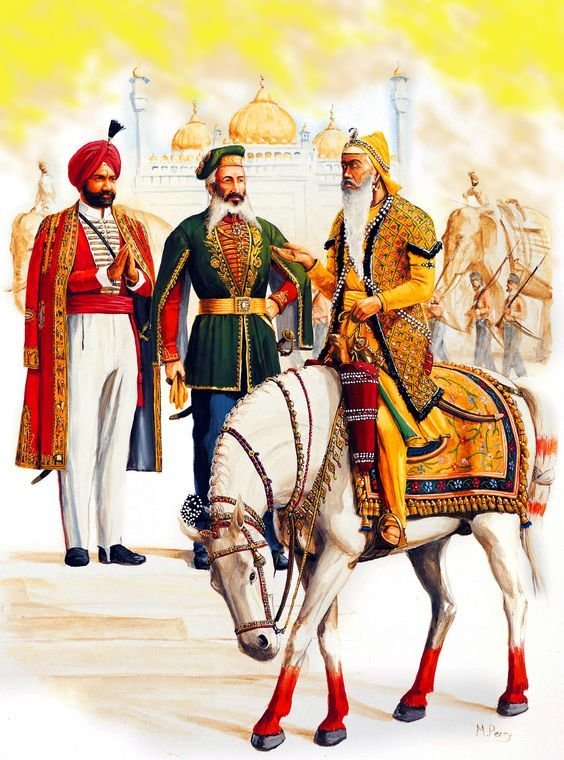
The Fauj-i-Khas: the “special force”, was Ranjit Singh’s most elite formation, and it wore its Napoleonic inheritance openly. Its standard strength was four infantry battalions, two cavalry regiments, and one troop of artillery carrying 24 guns. By the end of 1822, barely a year after Allard and Ventura’s arrival, it had already grown to five regiments and roughly 15,000 men.
It was drilled on French patterns, given French-inspired uniforms, and trained using military manuals that Allard and Ventura wrote and had translated into Persian and Punjabi, while carefully preserving the one thing that mattered most to its men: the Sikh soldiers kept their turbans, the wearing of which was a matter of faith, not just fashion. Orders were drummed out in formation, columns and squares were drilled to French timing, and a third of all troops stationed in Punjab by 1833 fell under this Firangi command, locally known as the Francisi Campu.
The Fauj-i-Ain: The Army Behind the Empire
The Fauj-i-Khas was the showpiece. The Fauj-i-Ain was the engine. This was Ranjit Singh’s regular standing army, and the numbers, carefully reconstructed by historian Sita Ram Kohli from the Sikh government’s own records, tell the real story of how fast this transformation happened.
Infantry and Cavalry strength:
| Year | Regular Infantry | Regular Cavalry | Irregular Cavalry |
|---|---|---|---|
| 1819 | 7,748 | 750 | 3,577 |
| 1823 | 11,681 | 1,650 | 7,300 |
| 1828 | 15,825 | 4,315 | 7,200 |
| 1838 | 26,617 | 4,090 | 10,795 |
Artillery strength:
| Year | Guns | Personnel |
|---|---|---|
| 1819 | 22 | 834 |
| 1828 | 130 | 3,778 |
| 1838 | 188 heavy cannon (plus ~20 howitzers, 60 light cannon) | 4,535 |
By 1838, when you count the regular army, the irregular Fauj-i-Be Qawaid, and the feudal jagirdari levies together, Ranjit Singh could call on something in the range of 50,000 trained men and a further reserve pool, drawn from the landed gentry and militia, estimated at nearly a quarter of a million. By the time of the Anglo-Sikh Wars a few years after his death, the Khalsa as a whole numbered close to 75,000.
This was not a cavalry of feudal levies waving swords. This was an army organized the way Napoleon organized his own, in self-contained brigades, each carrying its own slice of infantry, cavalry, and artillery, capable of operating independently. A typical Sikh brigade carried roughly 3,000 infantry, 1,500 cavalry, and 35 cannons, small enough to move fast, large enough to hit hard.
The artillery alone deserves its own footnote. Ranjit Singh divided his guns into four categories based on what hauled them: bullocks, horses, elephants, and camels, and by the 1830s his arsenal ranged from 48-pounder siege guns dragged by elephants down to light swivel guns, the zamburaks, carried on camelback for speed. The Sikh gun crews, mostly Punjabi Muslims, were noted by their British adversaries for their accuracy and rate of fire, a grudging compliment from the very army that would eventually face them at Ferozeshah and Sobraon.
How was an Army of 50,000 paid?
Here is the detail that rarely makes it into the heroic version of this story: for most of Sikh history before Ranjit Singh, soldiers were not paid a fixed wage at all. They were paid in jagirs, land grants, the old Mughal-Misl method, where loyalty was bought with territory rather than coin.
Ranjit Singh changed this, and it was as quietly revolutionary as anything his French generals did on the parade ground. As his standing army grew too large and too professional to run on land grants alone, he shifted the bulk of it onto a cash salary, paid directly from the state treasury not from the personal pocket of a local chief.
An infantryman could expect somewhere between 7 and 8 rupees a month. A cavalry trooper in the regular risalas earned considerably more, in the range of 250 to 300 rupees a year, reflecting both the cost of maintaining a horse and the higher prestige cavalry carried in Punjabi military culture. Soldiers received their pay at formal musters at the Royal Durbar itself, a detail that mattered, because it meant the Maharaja’s army answered to the state, not to a patchwork of feudal patrons.
The old jagirdari system didn’t disappear, it survived alongside the new one, particularly for the irregular cavalry and the old Misl aristocracy, who supplied their own horses and equipment and were still paid partly in land. But Ranjit Singh kept a tight leash on them too: he set exact rules for how many men a jagirdar had to produce, made surprise inspections of their estates, and turned the annual Dussehra review into a public reckoning of who had kept their contingent battle-ready and who hadn’t. Promotion across the army, regular and irregular alike, was meant to run on merit rather than birth, a meritocratic streak that was unusual for any army of that century, let alone one in early 19th-century India.
It is a small, almost bureaucratic detail, salary tables, muster rolls, treasury disbursements, but it is exactly this kind of administrative spine that turned the Khalsa from a collection of warrior bands into a state army capable of holding its own against the East India Company for as long as it did.
A History We Forgot to Carry with Us:
There is something quietly devastating about how little of this survives in our everyday memory as Punjabis. We sing of the Sher-e-Punjab in our ballads, we put his statue in our parks, we name our institutions after him and yet ask most of us how his army was actually built, that Frenchmen and Italians worked for the the King of Punjab, not how it is today, where all our Punjabi population is running to settle abroad.
We have inherited the legend without the ledger. We know that Ranjit Singh was undefeated, that his kingdom stretched from Kashmir to the Khyber Pass, that the British did not dare cross the Sutlej while he lived but we have let the texture of how that was achieved slip out of our hands. The Frenchmen who drilled our infantry in Lahore’s cantonments, the Italian who became a Kazi in our courts, the camel-mounted guns, the rupee-by-rupee arithmetic of paying 50,000 men on time, every month, from a treasury and not a feudal whim, these are not footnotes. They are the actual machinery of the only truly sovereign Punjabi state in recent memory, and we have let most of it fade into trivia.
Maybe that is the real inheritance we have lost, not the territory, which was always going to be contested, but the habit of looking closely at our own history instead of merely being proud of its outline. Ranjit Singh did not build an empire on charisma alone. He built it on a dream, a dream to have the best army with the best equipment, and an unusual willingness to let merit outrank birth. If we are going to claim him as ours and we should, we owe him the discipline of remembering him accurately, not just fondly.
